The archive is alive!
05 may 2026
By KHENSANI MOHLATLOLE
Nostalgia in African fashion is a special thing. Rarely is it about returning to a fixed point in the past. Instead, it often reflects a different understanding of time—one in which history is cyclical rather than linear. Like an ouroboros, the past and present continuously fold into each other. While it’s true that for many designers, childhood memories, family histories, and inherited craft traditions serve as the foundation of their work, within African fashion, where archives have often been fragmented, overlooked, or under-documented, referencing the past becomes something more active.
Designers are not simply retrieving history; they are participating in the creation of it. Their garments function almost like oral traditions—stories that adapt with each retelling, shaped by new contexts, audiences, and technologies. In this sense, fashion becomes both archive and storyteller. Designers such as Imane Ayissi, Kenneth Ize, Lisa Folawiyo, Mmuso Maxwell, and Yoshita 1967 reveal how memory, craft, and heritage can be reimagined with future-facing lens. Their work doesn’t merely reference African fashion and its history—it helps shape how that history will be understood by generations to come.
Imane Ayissi, Cameroon
Couturier Imane Ayissi approaches fashion as a synthesis of heritage, movement, and craftsmanship. A former member of the Cameroon National Ballet, Ayissi’s background as a dancer deeply informs his design practice: his garments emphasise drape, volume, and fluidity, highlighting the relationship between clothing and the body in motion. His collections draw on a wide range of African textiles and materials—raffia, Obom bark cloth, Faso Dan Fani stripes, and Kente—transforming traditional techniques into couture silhouettes that move between continents and histories.
Ayissi’s upbringing was in an artistic household—his father a champion boxer, his mother Miss Cameroon 1960, and several siblings, dancers and singers—and this sensibility is evident in collections such as Mbek Idourrou (Autumn/Winter 2019), whose title translates to “he or she who wears a garment that is impressive,” referencing the idea that clothing reflects both the wearer and the strength of their community. In 2020, Ayissi became the first designer from sub-Saharan Africa invited to present on the official Haute Couture calendar in Paris.

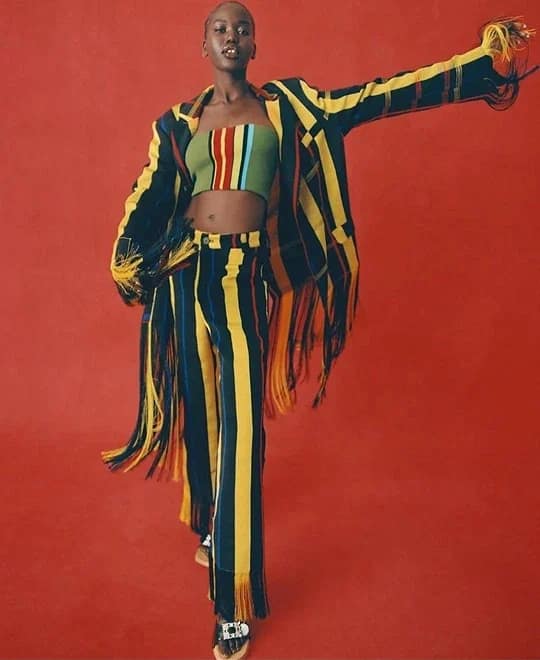
Kenneth Ize, Nigeria
For Kenneth Ize, fashion began with memory—specifically, the tactile richness of his mother’s wardrobe. Growing up in Austria, Ize recalls being captivated by the textures and colours of the traditional garments she wore to church, often pairing elaborate “trads” with Italian shoes and gold jewellery. One childhood image remains especially vivid: his mother’s silk Àṣọ-Òkè headwrap, worn to a friend’s party, a moment that would later shape his design language.
Àṣọ-Òkè, a handwoven Yoruba textile, sits at the centre of Ize’s practice. Rather than treating it as a ceremonial costume, he positions it within contemporary luxury fashion, collaborating with Nigerian weaving communities to produce vibrant striped fabrics for tailored jackets, coats, and dresses. As he explains, his work grew from “a hunger for my own interpretation of my culture and my identity.” His transnational upbringing allowed him to see local craft through a new lens: not simply as tradition, but as innovation. In doing so, Ize reconnects Nigeria’s textile heritage to the global fashion system, creating garments that link “the techniques and traditions that define Nigeria’s past with the ideas shaping its present.”
Lisa Folawiyo, Nigeria
Existing for over 20 years uniquely positions Lisa Folawiyo as a key reference point for a new generation of African designers. Folawiyo’s work has relied on reimagining and reworking Ankara, or Dutch Wax Prints, combining them with beadwork, applique and a global approach to pattern cutting and tailoring. A designer of mixed heritage (Nigerian and West Indian), her work has remained reflective of a type of Afropolitanism, harkening to the spirit of newly-liberated Africa where imagination ruled what African fashion could be, unbound by borders and imperial institutions. The designer is often thought to be ‘modernising’ traditional fabrics, but this not only presents a limiting view of these textile traditions, but it also misses how Folawiyo’s work is a continuation and not a disruption in tradition.
Throughout history, across the continent, artisans and designers have always transformed both indigenous and foreign inputs into a distinct visual language reflective of their times. Speaking to Glamour about the founding of her label, Folawiyo says, “I wanted to wear modern cool clothes that represented who I was and where I was from.” Her work draws from Yoruba, Igbo and Fulani craftsmanship, artfully revealing how dress once reserved for ceremony can exist in urban life, rejecting the ways in which African identity is seen as static and unchanging.


Mmuso Maxwell: South Africa
Recipients of the 2022 Woolmark prize, design duo Mmuso Potsane and Maxwell Boko work primarily with merino wool, which, while not indigenous, has grown to be one of South Africa’s most prized materials. Through basing their supply chain domestically, with wool sourced from Namaqualand to manufacturing in Johannesburg, Mmuso Maxwell’s contribution to the archive is rooted in ideas of self-authorship, as well as showing how foreign materials can be integrated into local identity through reframing them within specific cultural forms.
For Mmuso Maxwell, tradition and heritage are not limitations but springboards for contemplating the pluralistic nature of contemporary African identity, one which celebrates the tensions between the modern, traditional, global and local. For their first menswear collection, Obhuti Abatsha, (translating to ‘new men’), the designers looked to the spirit of traditional forms such as Basotho blankets and Xhosa ceremonial attire to define the new man. Two shirts in the collection feature a hand-drawn sketch of Boko’s aunt as a way to hold both memory and maternal influence in modern masculinity. While working within typically European tailoring, the duo has established their own signature through keyhole closures, asymmetric closures, and pleating, reflecting how local design languages can translate outside influence.
Yoshita 1967, Kenya
Founded by Anil Padia, Yoshita 1967 approaches fashion as a collective act of remembering. Rooted in Padia’s Kenyan-Indian heritage, the brand draws on intergenerational rituals of adornment—moments spent watching his mother, grandmother, and aunts carefully select jewellery and bangles before leaving the house. These early observations shaped his understanding of dress as something deeply meaningful rather than purely decorative.
Craft sits at the heart of Yoshita 1967. The brand collaborates with a collective of women artisans in Kenya, elevating techniques such as crochet and intricate hand embellishment that have long existed within local communities but have rarely been recognised within luxury fashion. For Padia, centring these practices is not simply about preservation; it is about visibility and value. Each hand-made garment becomes part of what he describes as an “evolving archive,” carrying forward overlooked skills while imagining new futures for them. In doing so, Yoshita 1967 redefines luxury as something rooted not only in exclusivity, but in lineage, labour, and shared cultural memory.
Yoshita 1967 sits firmly within a cohort of African designers from Cameroon to South Africa to Kenya who recognise history as a living creature, one with which we are in constant dialogue. These stories are valuable not only by themselves but for how they allow us to continuously reshape and reimagine our current realities in one of the most tangible and accessible ways: through the clothes we wear.