Objects that remember
A Deep Dive Into the Material Archive of Designing Through Recollection
16 aPRIL 2026
By sHAI RAMA
Design is a conversation across time. When contemporary designers draw from the intelligence of South Africa’s rural domestic landscape, they retrieve a vocabulary embedded in memory and the lived-in logic of things that worked because they had to. Function and feeling are paramount, carrying a sense of place and a design language no blueprint could replicate.
Furniture, ceramics, textiles and domestic objects are often shaped by recollection. In many childhood homes across the country, materials were chosen for durability, then transformed through use. Objects accumulated meaning over time: an enamel mug chipped at the rim, stained a faint brown from endless tea; a three-legged wooden chair with one leg replaced with a different timber, slightly shorter, permanently persuasive about balance. South Africans share this domestic pragmatism, transcending race and overriding difference. In working-class neighbourhoods from Durban to Cape Town and townships around Johannesburg, similar spatial habits recur: living rooms double as reception spaces, plastic-covered sofas, polished tile or cement floors, and multipurpose tables support gatherings and meals. Storage favours visibility: glass jars and stacked containers are kept within reach. Curtains filter strong light rather than frame views. Colour arrives through textiles and paint refreshed over time, not through seasonal reinvention or trend. These parallels grow from climate and the economics of maintenance. Corrugated roofing, deep eaves, burglar bars and shaded stoep areas answer heat and security in much the same way across communities. Repair culture is constant: furniture reinforced, appliances extended, surfaces repainted. The result is an environment shaped by use.
Zizipho Poswa
Poswa’s vessels are reminiscent of traditional pots, hand-coiled and burnished, sometimes over half a metre tall, a scale that recalls the ukhamba, a pot that can hold twenty litres of beer. These pots reference Umthwalo, the act of balancing a heavy load on the head — whether bundles of wood, buckets of water or piles of laundry — often carried over long distances by women Poswa observed while growing up in the Eastern Cape. Here, strength reveals itself in daily repetition, a nostalgia carried forward into a contemporary vessel that differs from the traditional pot only in that it is sealed. Her second series, Magodi, was inspired by the central role that hair salons play as meeting places for African women. Each work is named after a family member or close friend, giving vivid physical form to the artist’s own support network.


Andile Dyalvane
Alongside Poswa, Dyalvane co-founded Imiso Ceramics, a working studio and retail space dedicated to contemporary clay practice. Drawing from the dualities of his rural childhood and urban adulthood, his work bridges memory and modernity, shaping vessels, platters and functional objects for the home. His glazed earthenware vessels — Yenkonjane (Of the Swallows), iNgqweji (Nest) and Ihobo-hobo (Cape Weaver Bird) — reference birds, a natural inspiration with contemporary execution. Together, their vessels carry the weight and tactility of utilitarian objects once shaped for storage, carrying and ritual use. In this work, clay functions as an archive and a medium. When placed within contemporary interiors, these vessels anchor space through presence and meaning, offering a tactile counterpoint to refined architecture.
Recent Loewe Foundation Craft Prize 2026 finalists from Africa — Fadekemi Ogunsanya, Xanthe Somers and Baba Tree Master Weavers — also present work rooted in heritage, process and the future of craft.
Fadekemi Ogunsanya
Nigerian textile artist Ogunsanya’s works are informed by her training as an architect and her connection to Yoruba culture. We Are Not Lying, Your Language Is Not Enough is a hand-embroidered, beaded quilt using traditional Nigerian resist-dyeing called Adire Eleko. Through embroidery, beading and Yoruba script, the quilt acts as both image and message, inspired by objects and symbolism from her childhood in Lagos.

Xanthe Somers
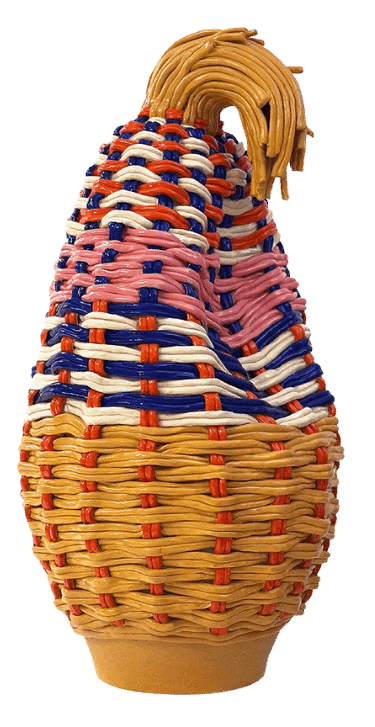
In Somers’ The Caretaker’s Clotheshorse, a coiled stoneware vessel slumps against its own internal frame, its woven-clay exterior referencing traditional Zimbabwean Binga baskets. At first glance, the vessels appear playful and exuberant, surfaces saturated with colour and animated by woven patterns that wrap around the clay. Yet beneath that brightness lies a more complicated investigation — a visual vocabulary through which she attempts to understand her position as a white Zimbabwean and the lingering shadow of colonial history in Zimbabwe.
Baba Tree Master Weavers
Fra Fra Tapestry #2, created by Baba Tree Master Weavers in collaboration with Álvaro Catalán de Ocón, is a communally woven elephant-grass textile that transforms overhead drone imagery of circular adobe housing in Ghana’s Gurunsi region into a graphic plan. The ‘interior’ spaces are then handed back to Ghanaian weavers for pattern and mark-making. The resulting tapestry operates simultaneously as map, architecture and textile, where circular compounds appear as rhythmic forms across the surface, their outlines rendered through tightly bound coils of elephant grass. Within those boundaries, the weavers introduce variations in colour and weave, turning each enclosed space into a field of individual expression. The work subtly mirrors the spatial logic of the settlements themselves, where communal structure coexists with private interior life.


Studio Bailiff
The plastic garden chair is an object found almost everywhere in the world — patios, sidewalks, backyards and street corners. With Studio Bailiff, designer Jordan Bailiff revisits this familiar silhouette and asks what happens when an object embedded in collective memory is rebuilt with care. Bailiff replaces moulded plastic with timber, transforming a disposable form into something slower and more deliberate. The gesture preserves the recognisable proportions of the original while allowing the grain and weight of wood to reshape its character.
Lebogang Tlhako
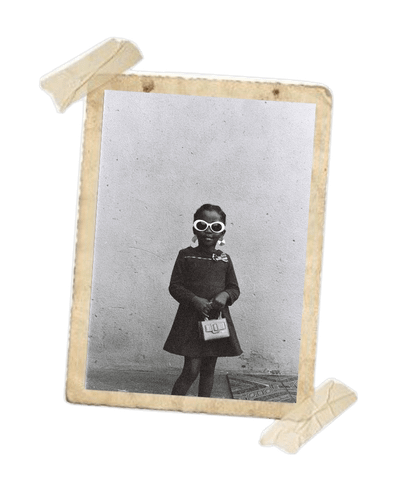
Photographer and creative entrepreneur Lebogang Tlhako, popularly known as Sisterbozza, weaves her roots in Katlehong with contemporary visual storytelling. In 2024, The Manor hosted her exhibition Sibadala Sibancane, a collection exploring her relationship with her mother and the influence it has had on her growth as a young woman. Her work echoes the era of family photo albums once central to middle-class femininity. The series features children wearing objects such as sunglasses and handbags, referencing the ideals of growing up too quickly. These images merge past and present, offering a glimpse into memory, identity and the ways personal and cultural histories shape everyday moments of childhood and adolescence.
Objects carry this past-to-future translation most clearly. Placed within contemporary interiors, these pieces become lieux de mémoire, and over time, contact deepens their character. Edges tarnish, colour shifts and surfaces record touch. The object holds memory as a material condition, becoming an inspiration point for the design of tomorrow.