
Uniforms of Belonging
From church uniforms and domestic worker overalls to pantsula style and contemporary fashion, this is the story of how South Africans transformed garments of control into symbols of identity, belonging and resistance.
16 July 2026
By Manor
South Africans really love a uniform. Which is odd when you consider how so many uniforms are shaped by colonialism, apartheid, labour, gender and control. Think of how young girls’ bodies are policed and surveilled in school uniforms, the tolls of physical labour revealed in the miner’s uniform, and, of course, how domestic overalls are often interpreted as permission to objectify and marginalise their wearer. However, upon closer inspection, the South African relationship to uniform isn’t so simple. Not all uniforms are evil. These garments can signify community, power and unity — think of DIY football jerseys, matching gowns for a bridal shower, or the unofficial wide-leg pants and Tabis of nonchalant fashion insiders. Human beings require individuality just as much as they do belonging. What’s interesting in South Africa, though, is how many uniforms were designed for the opposite of belonging — for division, hierarchy and making people small — and yet have been reworked, reimagined and sometimes completely inverted by the very people they were meant to contain.
One of the most familiar examples is the church uniform.
Across many domestic churches, particularly those with roots in colonial-era missions, uniforms were introduced as tools of “civilisation.” They were meant to reshape African women into European ideals of femininity — modest, disciplined and respectable. Mission schools weren’t interested in just teaching religion; they were training African women for service, prioritising sewing, laundry and domestic skills to prepare them for lives as workers in white households. But many women didn’t integrate into these systems out of ideological alignment or because they were convinced the White Man had the best argument. In the changing landscape of colonialism and, later, apartheid, mission schools offered one of the few paths to access — access to literacy, job opportunities and mobility necessary to survive the new world order.
Zion Christian Church devotees celebrate 2010 World Cup at the FNB stadium via Huffington Post, The Response (2024) by Wanda Lephoto
In a surprising number of cases, missionaries weren’t actually that successful at conversion — at least, it wasn’t just their sharing of the good book alone that Christianised local populations. Successful missions were those that provided land, resources and practical skills that suited the interests of their converts. It wasn’t a system of cut-and-dry submission but a complex series of negotiations. The church uniform is no exception.
The majority of European fashion was (and is) spiritually empty. In indigenous traditions, clothing functions as symbolic communication, denoting age, gender, marital status and connections to the spiritual world. By contrast, Western clothing felt empty, devoid of meaning, almost soulless. Because church uniforms were so tied to worship, they offered a sacramental engagement with foreign material culture, allowing African women a path to translate these alien practices into their own languages.
Uniforms often represent status and position, and in the face of systematic dehumanisation, the church uniform became a kind of armour. It was a way to signal to the self and to others the dignity, order and moral authority so often denied in the lives of African women.
But while church uniforms provided dignity, the domestic worker uniform is primarily notable for its lack of dignity and the insidious agenda of segregation and marginalisation.
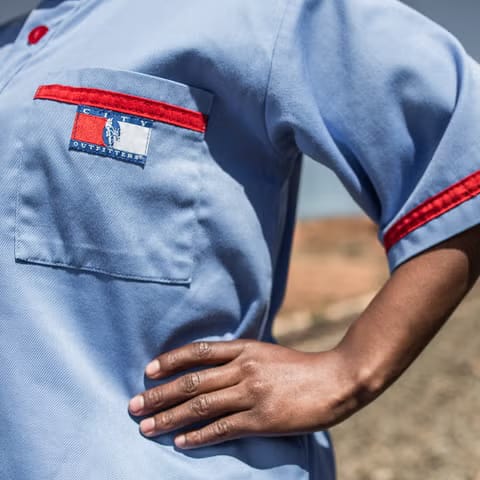
One has to question why, in our democratic rainbow nation, this uniform still exists. There’s nothing all that protective about these thin polyester pinafore dresses and, with just two pockets, how utilitarian are they? As protection from cleaning fluids and household tasks, what do these overalls offer that a T-shirt and jeans don’t?

A girl and her maid in apartheid South Africa by Peter Magubande
In more high-profile fields like nursing or airline service, uniforms tend to follow trends: the adoption of trousers for women, the introduction of flat shoes and silhouettes that mimic contemporary offerings. These overalls haven’t changed very much in over 50 years, save for less breathable fabrics and a range of “ethnic” prints and wrap-over styles. Either way, they’re not very functional and not very stylish, so why have they remained?
Most likely because they still serve their main function: creating social distance.
As scholars like Rebecca Ginsburg have shown, the intimacy of domestic labour — African women occupying white homes — required the constant reinforcement of hierarchy to create distance within proximity through spatial segregation (separate cutlery, rooms and furniture), linguistic hierarchy (forbidding African languages, addressing white people as “madam” or “sir”) and visual markers: the uniform.
This visual marker was especially important since domestic workers were a threat to the construction of traditional white womanhood. With African women performing all of the associated tasks of good wives and mothers — cooking, cleaning and raising children — the uniform ensured that, at least visually, the African presence underlying white femininity could be invisibilised.
It’s a presence difficult to ignore. By the 1950s, an estimated 90% of African women employed in Johannesburg were domestic workers. Almost every South African is connected to a domestic worker — whether through employment or through mothers, aunts and grandmothers in the field. To this day, it’s difficult to find an example where the position of maid, helper or domestic worker isn’t fulfilled by an African woman. She is one of the most constant figures in the shape of our nation and yet remains largely unseen.
This is what made the Economic Freedom Fighters’ (EFF) 2014 entrance into the political arena lightning in a bottle. Rejecting the suits of parliamentary decorum, they wore red overalls and pinafores, aligning themselves, at least symbolically, with the working class. Whether this was genuine solidarity or clever political theatre, the reactions revealed how little had changed about the status of the domestic worker uniform.
In the same year, the EFF were removed from the Gauteng legislature for “inappropriate” dress. What exactly about these outfits is unfit for parliament? Why is the suit — arguably the uniform of colonial bureaucracy, cannibalising capitalism and post-apartheid state capture — somehow neutral or respectable? As Julius Malema put it at the time: “To you proper is white, to you proper is European. We are not white; we are going to wear those uniforms.”
Uniforms, here, expose the politics of respectability. They reveal that what is considered “appropriate” is never neutral but rather a concession to existing racial and class hierarchies. Yet it would be naïve to separate the EFF’s fashioned resistance from the spectacle of political theatre — there are still voters to persuade and headlines to generate.

Julius Malema and Economic Freedom Fighters in 2021, via News24
I Am A Lady (2009) by Mary Sibande
As a corrective, Mary Sibande’s career-long interpretations and fantastical constructions offer new perspectives on domestic uniforms. Maids aren’t meant to be seen or heard, something Sibande challenges as she transforms the maid into monumental architecture. Through the character of Sophie — a domestic worker based on Sibande’s own maternal relations — the maid occupies space in a way she was never meant to, through expansive coloured gowns, exaggerated Victorian silhouettes and otherworldly embellishments. The uniform becomes a site of fantasy and fabulation, a meeting point for the world as African women see it.
Through collaborations with designers like Nkhensani Nkosi and Palesa Mokubung, Sophie’s wardrobe expands, incorporating elements of African dress while complicating the visual language of both colonial and contemporary fashion.
It is a reminder that while fashion is deeply entangled in systems of exploitation — particularly within the Global South — it is also a space of imagination. A space where histories can be rewritten.
Another, lesser-discussed uniform is the kitchen suit and its rather unconventional history.
In the late nineteenth and early twentieth centuries, before industrialisation rapidly expanded labour, many African men migrated to urban areas to work as domestic servants. They were provided with a uniform — a khaki tunic and shorts with coloured striping indicating their domestic domain — commonly referred to as a “kitchen boy suit.”
This uniform made their subordination visible and allowed greater surveillance and control of the large waves of African men entering supposedly white territory. One of the key shames for men at the time was how these uniforms served to emasculate them under white supremacy. It was a short-lived period, as the Great Depression and the gold rush boom increased demand for migrant labour in mining and industry, while African women became the preferred labour force for domestic work. There were even scare campaigns around the perceived physical and sexual threat of African men living in close proximity to white women to help usher in this change.

Photos by Chris Saunders, 2018
This made it quite a shock when, in the 1970s and 1980s, township youth reclaimed the kitchen suits of their fathers and grandfathers as an act of fashion and defiance.
Within pantsula culture, the suit was recontextualised — no longer a marker of submission but of township masculinity and showmanship. Voluntarily choosing to wear the uniform, rather than being forced into it, removed the stigma of shame and inferiority. It also confused white onlookers who expected the submission of a domestic worker but were instead confronted with a statement of rebellion.
There is perhaps also a covert quality to the kitchen suit in pantsula, akin to early protest T-shirt culture in South Africa. When T-shirts printed with Steve Biko’s face were made for his memorial following his assassination, they were stripped of text so anti-apartheid activists could move unnoticed past authorities and white observers. For the average white person at the time, Steve Biko simply looked like any other Black man.
Perhaps that is also how the kitchen suit functioned — allowing members of the counterculture to identify one another, organise and build community while remaining undetected. Those very white observers may even have been more lenient, interpreting the uniforms as signs of submission.
It allowed for recognition without detection, while opening conversations around gender and disruption, reminiscent of Winnie Madikizela-Mandela’s use of uniform during the same period. Her shift from traditional dress and hyper-feminine silhouettes to military fatigues marked a transformation not only in style but in political language. Yet both umbhaco and combat gear functioned as resistance. One spoke through cultural continuity and indigenous knowledge, the other through confrontation and rebellion, qualities not typically associated with femininity.

Photo by Chris Saunders, 2016
“Boys wear Yves Klein” (2025) by Siyababa Atelier
More recently, designers like Siyababa Mtshali have queered the labour uniform itself. In his work, the blue overall — a symbol of heteromasculine labour — is destabilised. Lace, satin and exposed undergarments transform the uniform into a site of contradiction. Mtshali reveals how colonialism did not simply reorganise labour but also imposed rigid frameworks of gender and sexuality. The uniform, once a marker of “real men,” becomes something far more fluid and far more unsettling.
Uniforms are a particular dialect in South Africa’s visual lexicon — a language through which we discuss belonging, authority and resistance. Like any language, they are open to reinterpretation, misuse and reinvention. In South Africa, uniforms remind us that what we often dismiss as aesthetics or ornamentation is deeply rooted in social, cultural and historical power. They have helped people find belonging in places they were never meant to exist.